The short answer
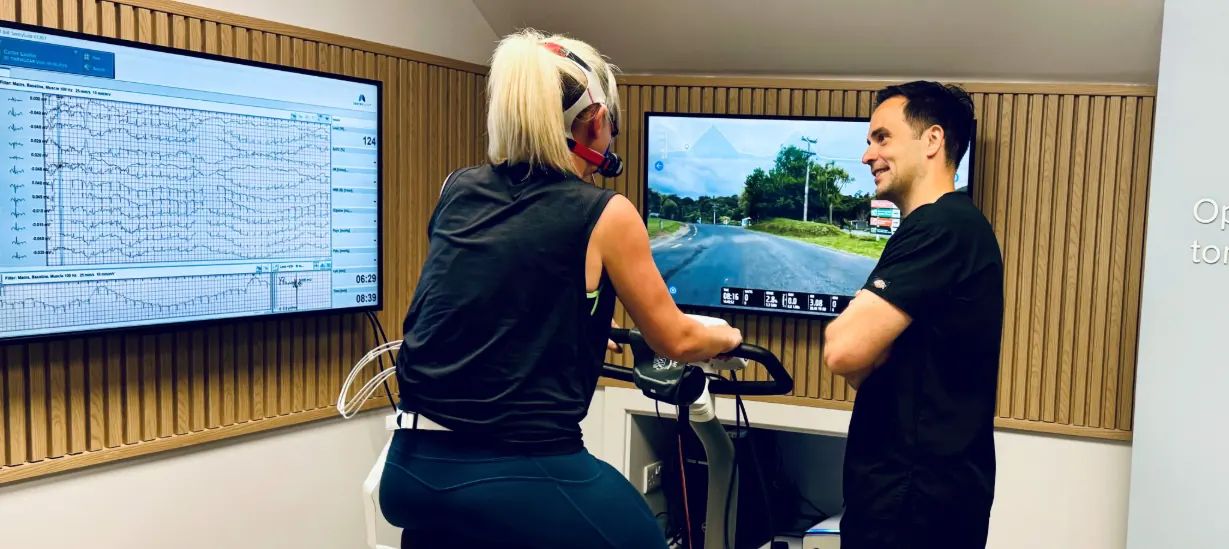
A cardiopulmonary exercise test (CPET) measures how well your body takes in oxygen, carries it in your blood and uses it to make energy, while you exercise on a bike wearing a breathing mask. We combine it with an ECG at rest and an ECG while you exercise.
At Tomorrow, CPET and the exercise ECG are part of the Health Check (£799), Ultimate (£1,299) and Ultimate+ (£1,799). Every Health Check, including Insight, has a resting ECG.
Why test during exercise
Many heart and lung problems are not apparent while your body is resting. Exercise places extra demands on your cardiovascular and respiratory systems, and can reveal limitations that would otherwise go unnoticed.
A standard exercise test mainly looks at the heart’s electrical activity. CPET goes further: breath-by-breath analysis shows how effectively your body takes in oxygen, transports it through your bloodstream and uses it to generate energy, as the effort increases.
Five areas of your health it assesses
- HeartHow your heart responds to exercise, including heart rate, electrical activity and indicators of cardiovascular performance.
- LungsHow well your lungs ventilate during exercise, and whether your breathing limits what you can do.
- FitnessYour body’s combined capacity to deliver and use oxygen: cardiorespiratory fitness, an important marker of long-term health.
- MetabolismHow your body uses fat and carbohydrate as fuel, and how that changes as the exercise gets harder.
- TrainingYour current capacity, your physiological thresholds and the exercise intensities that suit your goals.
The eight measurements, explained
1. Peak oxygen uptake (VO2 max)
The highest rate at which your body can use oxygen during intense exercise, reported in millilitres of oxygen per kilogram of body weight per minute. It reflects how your heart, lungs, circulation and muscles perform together.
- One of the most useful objective measures of overall exercise capacity.
- Higher cardiorespiratory fitness is strongly linked with lower cardiovascular and all-cause mortality in population studies.
- A useful benchmark for tracking how your capacity changes as you age, or as you train.
- A lower than expected result can prompt a look at heart, lung, muscle, blood or deconditioning factors.
Good to know: what counts as a good result depends on your age, sex, body size, medical history and the effort you reach. A normal VO2 max does not rule out coronary artery disease.
2. Anaerobic threshold
The exercise intensity at which your body’s metabolic and breathing responses begin to change as the workload rises. It shows how much sustained activity you can do before fatigue builds more quickly.
- Two people can have a similar VO2 max but different thresholds: the one with the higher threshold can sustain more of their maximum for longer.
- It helps set the right aerobic training intensity for you, and shows how your endurance changes with training.
Good to know: a low threshold is not specific to heart disease. It can also reflect deconditioning, anaemia or lung disease.
3. Ventilatory efficiency (VE/VCO2 at the threshold)
How much air you need to breathe to clear a given amount of carbon dioxide. It shows how efficiently your breathing and gas exchange respond to exercise; lower values within the expected range mean more efficient breathing.
- Helps explain unusual breathlessness during exertion.
- Shows whether heart or lung limitations may be affecting gas exchange.
Good to know: a raised value is not a diagnosis on its own. It is interpreted alongside your breathing pattern, oxygen uptake and the wider assessment.
4. Breathing reserve
How much of your breathing capacity is left unused at peak exercise. Plenty of reserve makes it less likely that your lungs’ mechanics are what stops you; very little may point to a ventilatory limit, although some well-trained athletes also use a large share of their capacity.
Good to know: it is especially useful when breathlessness is unexplained, but it is not a test for asthma, COPD or other lung diseases on its own.
5. Oxygen pulse
The oxygen you use per heartbeat (oxygen uptake divided by heart rate). It reflects how much blood your heart pumps with each beat and how much oxygen your tissues extract, so it is an indirect guide to how your circulation responds to exercise. It normally rises steadily as the effort increases.
Good to know: it does not directly measure the heart’s output or the blood flow in the coronary arteries, and an unusual pattern cannot diagnose coronary artery disease by itself.
6. Fat-burning efficiency (FATmax) and training zones
How your body uses fat and carbohydrate for energy at different intensities. FATmax is the intensity at which you burn fat fastest, expressed as a heart rate, power output or share of your VO2 max. Fat use usually rises with intensity, peaks, then falls as carbohydrate takes over.
- Training zones set from your own measured thresholds, rather than estimated from your age.
- A way to track how your fuel use changes as you train.
Good to know: a higher FATmax does not automatically mean better metabolic health or less body fat, which depends on many factors, including your overall energy balance. Recent meals and exercise also affect the result.
7. Resting ECG
A 12-lead recording of your heart’s electrical activity while you are at rest. It shows your heart rate and rhythm and how electrical signals travel through the heart. Some patterns can suggest a thickened heart muscle, a previous heart attack, electrolyte disturbances, medication effects or inherited electrical conditions.
Good to know: it is a valuable baseline before exercise, but a normal resting ECG does not exclude coronary artery disease, rhythm problems that come and go, or structural heart disease.
8. ECG during exercise (stress ECG)
Continuous monitoring of your heart’s electrical activity as the workload increases. It looks for abnormal rhythms during exertion, changes that may suggest the heart muscle is short of oxygen, whether your heart rate rises appropriately, and how quickly it recovers afterwards, and whether any symptoms coincide with ECG changes.
Good to know: it can pick up findings that need further investigation, but its accuracy for narrowed coronary arteries is limited: a normal result does not reliably rule out coronary plaque.
How the results work together
The real value comes from reading the measurements together rather than one at a time.
| Measurement | Main information |
|---|---|
| VO2 max | Overall cardiorespiratory fitness and peak exercise capacity |
| Anaerobic threshold | Sustainable aerobic exercise capacity |
| VE/VCO2 | How efficiently you breathe |
| Breathing reserve | Whether your breathing may limit exercise |
| Oxygen pulse | Indirect information about how your circulation responds |
| FATmax | How you use fuel, and the right training intensities for you |
| Resting ECG | Your baseline heart rhythm and electrical activity |
| Stress ECG | Your heart’s rhythm and electrical response under exertion |
Example: unexplained breathlessness
Someone becomes unusually breathless climbing the stairs. A reduced VO2 max with raised VE/VCO2 and plenty of breathing reserve could raise suspicion of a circulation or lung-circulation problem. A reduced VO2 max with little breathing reserve might point to a breathing limitation instead. Reduced fitness with otherwise normal responses can suggest deconditioning. None of these is a diagnosis by itself, but telling the patterns apart is one of CPET’s great strengths.
What the test can’t tell you
CPET shows how well your cardiovascular system performs. It doesn’t show whether disease is present in your arteries. On its own, it does not establish:
- whether your coronary arteries contain plaque, or your coronary calcium score;
- every significant narrowing of the coronary arteries;
- your heart’s structure, valves or pumping strength (an echocardiogram shows these);
- your cholesterol, ApoB, Lp(a), glucose or HbA1c (your blood analysis measures these);
- whether you will have a heart attack or stroke in future.
That is why we read your exercise test alongside your history, blood pressure and blood results and, in Ultimate and Ultimate+, imaging of your arteries, which looks directly for plaque.
Why it is clinically valuable
- Investigation: it helps explain exercise intolerance and unexplained breathlessness, and identifies findings that need further tests.
- Health and risk: it measures cardiorespiratory fitness, a strong marker of future health that adds to conventional risk factors.
- Optimisation: it sets objective fitness benchmarks that guide personalised training and show how you change over time.
Why specialist interpretation matters
The quality of a CPET depends on the expertise of the people who run and read it. At Tomorrow, the test is supervised and interpreted by specialist doctors who use exercise testing in clinical practice and research, and your results are explained to you on the day, with your history, symptoms and other results in mind.
A full report also covers your blood pressure response, how long you exercised and at what workload, your heart rate recovery, why the test stopped and whether you reached a maximal effort.
When to see a doctor instead
Call 999 for chest pain or tightness, especially if it spreads to your arm, jaw or back, severe breathlessness, or fainting.
See your GP or call NHS 111 for new or worsening breathlessness, swollen ankles or palpitations. A private health check is not a substitute for urgent care.
Questions
Do I need to be fit to do the exercise test?
No. The effort increases gradually and the test is about how your body responds, not reaching a target. It is supervised throughout, and you can stop at any time.
Is CPET the same as a stress ECG?
No. A stress ECG records your heart’s electrical activity during exercise. CPET adds breath-by-breath analysis of the oxygen you use and the carbon dioxide you breathe out, which shows how your heart, lungs, circulation and muscles work together. We do both at the same time.
Which Tomorrow Health Checks include the exercise test?
The Health Check (£799), Ultimate (£1,299) and Ultimate+ (£1,799) all include CPET with VO2 max and a stress ECG. Insight (£299) includes a resting ECG.
Can a smartwatch tell me my VO2 max?
A smartwatch estimates VO2 max from your heart rate and pace. CPET measures it directly from the air you breathe, and benchmarks it for your age and sex.